


Key Takeaways
- A/B testing email marketing means sending two versions of an email (such as different subject lines, CTAs, or send times) to different segments to see which performs better based on key metrics like open rates and click through rates, helping improve overall email performance.
- Even small businesses and nonprofits with lists as small as 2,000–5,000 contacts can run meaningful A/B tests using tools like VerticalResponse’s built-in split testing features.
- A good test starts with one clear goal (for example, boost open rate from 18% to 22% on a May 2026 newsletter) and one variable (such as subject line) so test results are easy to interpret.
- Achieving statistical significance in A/B testing is crucial to ensure your results are reliable and not due to random chance; this requires a sufficient sample size and proper test timing.
- Consistent A/B testing on core campaigns—welcome series, monthly newsletter, and key promotions—can compound into 10–30%+ improvements in opens, clicks, and donations or sales over a few months.
- This article is written from VerticalResponse’s perspective and will show how to design, run, and analyze A/B tests inside a typical email marketing workflow, plus give concrete test ideas and FAQs.
What Is A/B Testing in Email Marketing?
A/B testing, often called split testing, is the practice of comparing two versions of the same email—Version A and Version B—sent to different audience segments to determine which wins on a metric like open rate or click through rate. Instead of guessing what content resonates with your subscribers, you let actual behavioral data guide your decisions. Using an email marketing platform designed for small businesses and nonprofits makes it easier to set up these tests and interpret which version drives better engagement.
Here’s what this looks like in concrete terms: Version A might use the subject line “Spring Sale – 20% Off Through April 30, 2026” while Version B uses “Your April 2026 Member Discount Inside.” Both versions are sent on the same day to randomized subsets of your list. By testing multiple versions of your email, you can compare performance and identify which approach is most effective. After a set period, you compare the results and declare a winner.
In email marketing, the variable you test can include:
- Subject lines and preview text
- Sender names (company name vs. personal name)
- Body copy length and style
- Layout and design elements
- Call to action buttons (color, text, placement)
- Offers and discount structures
- Send time and day of week
Optimizing these elements helps maximize engagement with your audience.
The key rule for simple, actionable tests? Change only one variable per test. When you modify multiple elements simultaneously, you can’t determine which change drove the observed difference in performance.
A/B testing proves especially valuable for recurring email campaigns like monthly newsletters, quarterly fundraising appeals, and weekly ecommerce promotions. Each test builds valuable data about your audience preferences, and those learnings carry forward to improve future campaigns.
It’s worth noting the difference between A/B testing and multivariate testing. While an email A B test compares two versions with a single variable changed, multivariate testing examines many combinations of changes at once. Multivariate testing requires significantly larger sample sizes—often 4-8x more recipients—and takes longer to reach reliable results. For most small businesses and nonprofits, straightforward A/B tests deliver faster, more actionable insights without the complexity. A/B testing can also be applied to other marketing assets, such as landing pages or pop-ups, to improve your overall marketing strategy.

How Email A/B Testing Works Step by Step
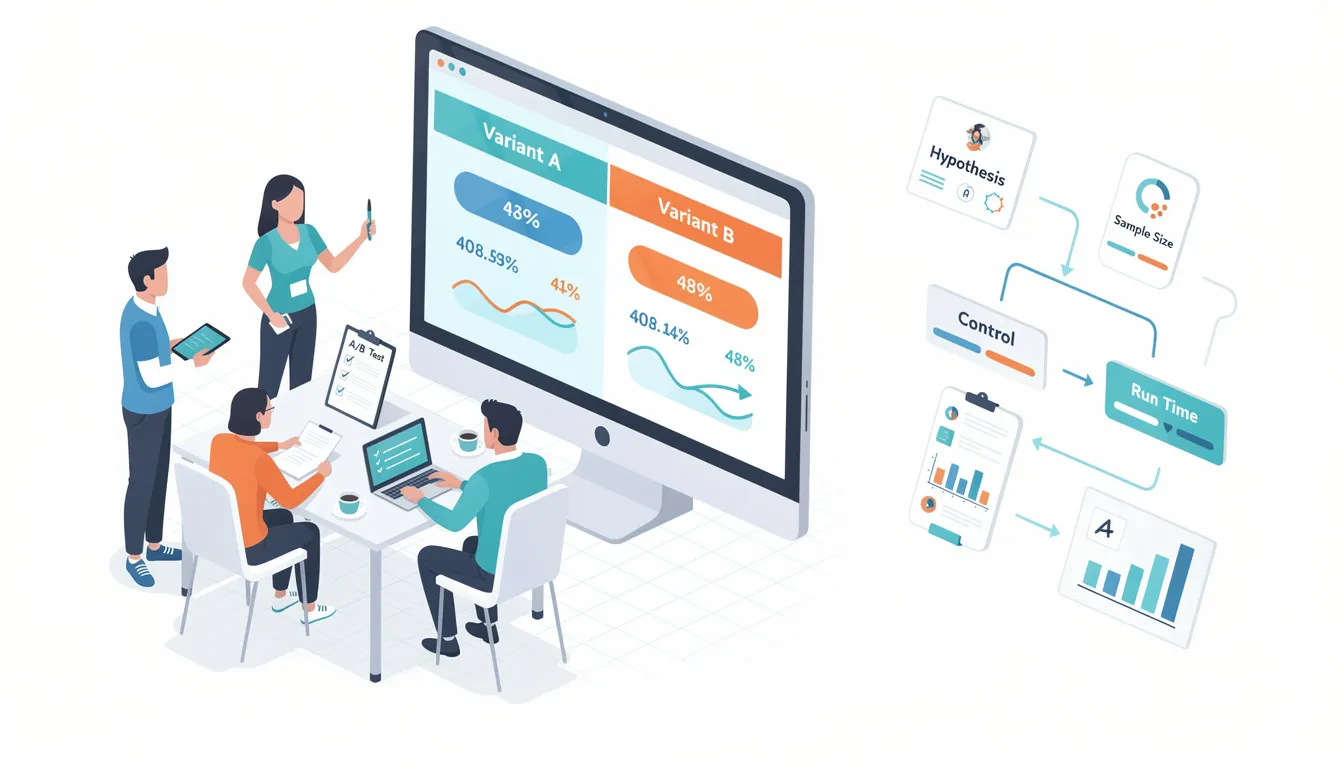
The basic workflow for any email A B test follows a predictable pattern: choose a goal, pick one variable, create Version A and Version B, split the list, send simultaneously, measure performance, and roll out the winning version to the remainder of your audience.
Let’s walk through this with a concrete example. Imagine you’re running a nonprofit and planning a June 2026 campaign asking for mid-year donations. Your list has 4,000 subscribers, and you want to test whether a question-based subject line outperforms a statement-based one.
Step 1: Define your goal and hypothesis Your goal is to increase open rates on your mid-year appeal. Your hypothesis: “A question-based subject line will increase opens by at least 15% compared to a statement-based subject line.”
Step 2: Create your two versions
- Version A (control): “Support Our Summer Programs”
- Version B (variation): “Can You Help 50 Kids This Summer?”
Everything else—preview text, sender name, email content, send time—stays identical across both versions.
Step 3: Split your test audience Set aside 20% of your list (800 subscribers) as the test group. Split this 50/50, so 400 people receive Version A and 400 receive Version B. The remaining 80% (3,200 subscribers) will receive the winning email after you’ve determined which performs better.
Step 4: Send simultaneously Both versions go out at the same time on the same day. This controls for external factors like time-of-day effects, news events, or day-of-week patterns that could skew your test results.
Step 5: Measure and analyze After 24-48 hours, check your email report. If Version B achieved a 28% open rate compared to Version A’s 22%, you need to determine if the difference is a statistically significant result. Only a statistically significant result ensures the observed difference is reliable and not due to random chance. If the difference is statistically significant, Version B wins.
Step 6: Roll out the winner Send the best performing version to the remaining 80% of your list, maximizing the impact of your campaign.
Random list splitting matters. If you accidentally put all your most engaged subscribers in one group, your test results won’t reflect true audience preferences—they’ll reflect segment differences.
The core metrics you’ll track depend on what you’re testing:
|
Test Type |
Primary Metric |
Secondary Metrics |
|---|---|---|
|
Subject line tests |
Open rate |
Click through rate |
|
CTA tests |
Click through rate |
Conversion rate |
|
Offer tests |
Conversion rate, Revenue |
Click through rate |
|
Send time tests |
Open rate |
Click through rate |
|
One important note: privacy changes like Apple Mail Privacy Protection (introduced in 2021) can inflate open rates by pre-loading tracking pixels. This means click through rates and conversion rates often provide more accurate data than opens alone, especially if a significant portion of your list uses Apple devices, making it vital to focus on metrics that matter beyond open rate. |
|
|
Benefits of A/B Testing Your Email Campaigns
For small businesses and nonprofits relying on email as a primary marketing channel in 2026, A/B testing offers significant advantages. Industry research consistently shows email marketing delivers strong returns—often $36-$42 per dollar spent—and methodical testing helps you capture more of that potential.
Reduces risk on new ideas
Want to try a bold new discount offer, a different tone in your fundraising ask, or a completely redesigned email template? A/B testing lets you try these ideas on a small subset before committing your entire list. If your experimental approach falls flat, only 10-20% of subscribers see it. If it works, you’ve discovered a new tactic to deploy at scale.
Builds first-party data about your audience
Every test generates valuable data about how your specific audience responds. You’ll learn that your local restaurant’s subscribers open more emails on Thursdays at 4 p.m. than Mondays at 9 a.m. Or that your nonprofit’s donors respond better to specific impact numbers than general appeals. This isn’t borrowed industry benchmark data—it’s your own audience’s behavior.
Creates compounding improvements
Small gains add up. If A/B testing increases your open rate from 18% to 22%, and subsequent tests boost your click through rate from 2.5% to 3.5%, the combined effect is substantial. That same list could generate 20-30% more orders, donations, or registrations by Q4 2026 without adding a single new subscriber.
Strengthens strategic decision-making
Resource-constrained teams often make marketing decisions based on intuition or what worked last year. A/B testing replaces guesswork with data driven decisions. When presenting results to your board, leadership, or stakeholders, you can point to specific test data showing why your email marketing strategy takes a particular approach.
Justifies tool investments
When you can demonstrate that A/B testing in VerticalResponse led to a 25% increase in click through rates over six months, it’s much easier to justify the continued investment in quality email marketing tools and select from pricing and plan options that match your list size and goals.
How to Plan and Run an Email A/B Test
This section provides a repeatable framework that any small business owner, marketer, or nonprofit coordinator can follow. We’ll use a practical example: a July 2026 summer sale for a local retailer with a 6,000-subscriber list. Identifying and testing key messages in your emails can help determine what resonates most with your audience, ensuring your main points—such as pricing, discounts, or special offers—are communicated effectively.
Step 1: Define Your Goal and Hypothesis
Start with a measurable goal tied to a specific campaign performance issue. Vague goals like “improve our emails” won’t guide effective tests.
Good goal example: “Increase July newsletter click through rate from 3.0% to at least 4.0%”
Testable hypothesis: “A shorter, action-oriented CTA button (‘Shop Sale’) will increase clicks by at least 25% compared to our current descriptive CTA (‘Browse Our Summer Collection’)”
Your hypothesis should be specific enough that after the test, you can clearly say whether it was confirmed or not.
Step 2: Select One Variable
Match your variable to your goal:
- Open rate problems? Test subject lines, preview text, or sender names
- Click through issues? Test body copy, layout, images, or CTA buttons
- Conversion or revenue problems? Test offer types, discount amounts, or landing pages
For our summer sale example, we’re testing CTA button text to improve clicks.
Step 3: Set Up Your Test
Configure your test parameters:
- Test group size: Use 10-20% of your list as the test group. With 6,000 subscribers, that’s 600-1,200 people.
- Split ratio: Divide the test group 50/50 between Version A and Version B
- Test duration: Allow enough time for your typical audience to engage—usually 24-48 hours for promotional emails
- Winning metric: Pre-select whether you’re judging on open rate, click through rate, or another metric
Critical operational details:
- Send both variants at the exact same time on the same day
- Keep everything identical except your single test variable
- Don’t check results after 2 hours and declare a winner—let the test duration complete
Step 4: Analyze Results and Roll Out
After your test duration completes, examine the data:
|
Version |
Recipients |
Clicks |
Click Rate |
|---|---|---|---|
|
A (“Browse Collection”) |
500 |
18 |
3.6% |
|
B (“Shop Sale”) |
500 |
27 |
5.4% |
|
Version B shows a 50% improvement in click rate. If this difference is statistically significant (more on that in best practices), send Version B to the remaining 5,400 subscribers. |
|
|
|
Step 5: Document Everything
Create a simple log tracking your tests:
|
Date |
Campaign |
Variable |
Winner |
Uplift |
Notes |
|---|---|---|---|---|---|
|
July 2026 |
Summer Sale |
CTA text |
“Shop Sale” |
+50% CTR |
Short, action-oriented wins |
|
Over 2026-2027, this log becomes your organization’s playbook, revealing patterns in what works for your specific audience. |
|
|
|
|
|
Best Practices for A/B Testing Email Marketing
Well-designed tests save time and prevent misleading results. Follow these core practices to ensure your testing process produces accurate data you can trust.
Test One Variable at a Time
This rule is non-negotiable for clear results. Here’s what goes wrong when you ignore it:
Bad approach: For your August 2026 back-to-school campaign, you test Version A (your standard template with subject line “Back to School Deals” and blue CTA) against Version B (new template with subject line “Save 30% on School Supplies 📚” and orange CTA).
Version B performs better—but why? Was it the subject line? The emoji? The template design? The CTA color? You can’t know, so you can’t confidently apply learnings to future email campaigns.
Good approach: Test only different subject lines for August. Test only CTA colors in September. Build knowledge systematically.
Set Clear Hypotheses and Success Metrics Upfront
Before you create testing variations, write down what you expect to happen and how you’ll measure success.
Example: “If we personalize subject lines with first names, open rates on our September 10, 2026 appeal will increase by at least 15%”
This prevents post-hoc rationalization where you convince yourself any difference was meaningful.
Understand Statistical Significance
Statistical significance tells you whether your observed difference likely reflects real audience preferences or could have happened by random chance. Most marketers aim for 95% confidence—meaning there’s only a 5% chance the results occurred randomly.
You don’t need to calculate this manually. Free online A/B test calculators let you input your sample size and conversion rates to check significance. Many ESPs, including VerticalResponse, have built-in significance tools.
For lists under a few hundred per variant, focus on directional learning rather than strict statistics. Look for large, obvious differences and confirm patterns across multiple tests.
Use Adequate Sample Sizes
With very small samples (under 200 contacts per variant), random variation can easily produce misleading results. If you have a tiny list, recognize that single tests provide suggestive rather than conclusive data points.
For hyper-niche B2B lists or very small nonprofits, run the same test across multiple campaigns over time to see if patterns hold.
Get Timing Right
Avoid testing during unusual periods:
- Major holidays when engagement patterns shift
- Breaking news events that might distract subscribers
- Your organization’s own unusual circumstances (website down, major announcement)
Also, don’t stop a test after the first hour if your normal engagement window spans 24+ hours. Email engagement often follows predictable patterns—some subscribers check email first thing in the morning, others in the evening. Cutting tests short misses significant portions of your audience.
Consider Segmentation as Advanced Testing
Once you’ve mastered basic A/B tests, explore whether winners hold across specific audience segments. The subject line that wins overall might underperform among your most valuable donors or repeat buyers.
Using your segmentation strategy, check if the winning email performs consistently across groups like:
- High-value donors (over $200 lifetime)
- Recent purchasers (last 90 days)
- New subscribers (joined in 2026)
- Geographic segments
What to A/B Test in Your Emails (Ideas & Examples)
This section provides specific, ready-to-use ideas for tests across subject lines, content, design, offers, and timing. Each example is anchored to realistic 2026 scenarios for small businesses and nonprofits.
Transactional emails, such as order confirmations and password resets, are also important candidates for A/B testing to ensure essential communications are optimized, and seasonal campaigns can benefit from high-impact holiday email subject line ideas tailored to busy inboxes.
Inbox Elements: From Name, Subject Line & Preview Text
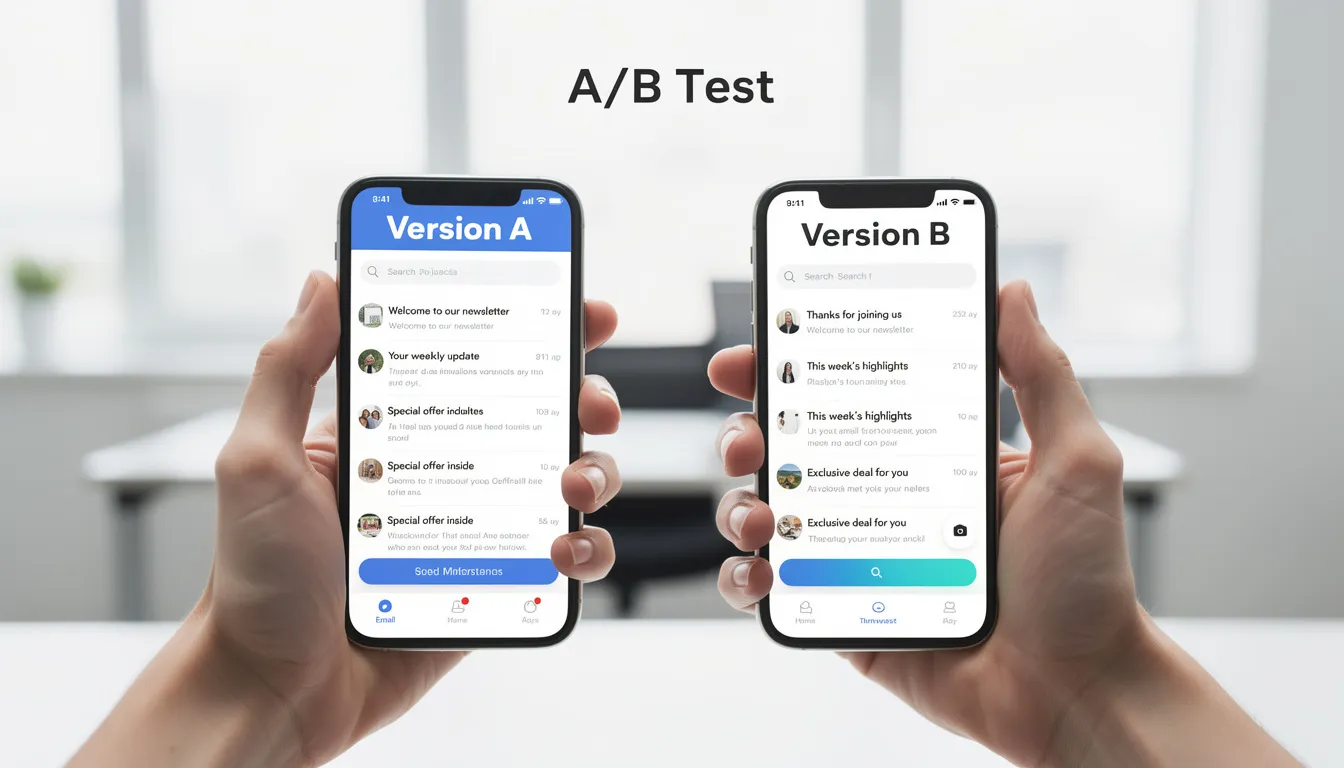
Tests on inbox elements happen “before the open.” Improvements here typically show up in open rates and overall list engagement.
Sender Name Tests
The “from” name establishes trust before subscribers even see your subject line. Test different versions to see what feels more trustworthy or personal to your audience:
- “VerticalResponse Team” vs. “Laura from VerticalResponse”
- “City Arts Council” vs. “Megan at City Arts Council”
- Your company name alone vs. company + department (“Smith Bakery” vs. “Smith Bakery Rewards”)
Subject Line Tests
Email subject lines offer endless testing opportunities, and studying top-performing subject line examples and strategies can give you a strong starting point for what to test:
|
Test Type |
Version A |
Version B |
|---|---|---|
|
Length |
“May Newsletter” |
“Your May 2026 Marketing Checklist: 7 Quick Wins” |
|
Curiosity vs. Clarity |
“Something special for you” |
“15% off your next order through May 15” |
|
Personalization |
“Don’t miss our spring sale” |
“[First Name], don’t miss our spring sale” |
|
Emojis |
“Summer classes start June 1” |
“☀️ Summer classes start June 1” |
|
Question vs. Statement |
“New items added this week” |
“Ready to refresh your wardrobe?” |
|
Research suggests emoji in subject lines can boost opens by 5-10% in many B2C contexts, but test this with your own audience—professional B2B lists may respond differently, and be sure to avoid common subject line mistakes that hurt opens. |
|
|
For shorter subject lines, front-load the most important information. Mobile email clients often truncate after 30-40 characters.
Preview Text Tests
Preview text (the snippet visible after the subject line) offers another testing opportunity:
- Reinforce the offer: “Save 20% through May 12, 2026”
- Answer a question raised in the subject line: “Here’s what’s inside…”
- Create urgency: “Only 72 hours left”
- Provide additional context not in the subject line
In-Email Content: Copy, Layout & Personalization
These tests affect what subscribers see after opening. Track click through rates and click-to-open rates to measure success, and follow email design do’s and don’ts for layout, images, and CTAs so your variations stay user-friendly and on-brand.
Copy Length and Style
Test whether your audience prefers detailed storytelling or scannable, brief content, and pull from a wide range of newsletter content ideas and topics so your tests compare genuinely interesting messages:
- Long-form storytelling: A 500-word September 2026 nonprofit impact update sharing one family’s detailed story
- Short, scannable copy: The same update condensed to 150 words with bullet points and statistics
Track which drives more clicks to your donation or volunteer signup page.
Layout Tests
- Single-column vs. multi-column design
- Hero image on top vs. headline first
- Text-heavy design vs. image-heavy visual layout (particularly relevant for ecommerce lookbooks or event promotion)
- Static images vs. GIF or animated elements
Research suggests image-heavy versions can outperform text-only by 12% in click through rate for visual sectors like fashion and food.
Personalization Beyond Subject Lines
Dynamic content lets you show different versions to different subscribers based on their data:
- Show different product categories based on past purchase behavior
- Display suggested donation amounts based on giving history
- Feature local event details based on geographic segments
Compare engagement on personalized versions against a generic version to measure the impact. VerticalResponse users can leverage segments (recent purchasers, lapsed donors, 2024 event attendees) to run these tests without deep technical skills.
Design & Calls-to-Action (CTAs)
CTAs and visual design elements directly influence click through rates and conversions. Small changes here can produce significant results.
CTA Button Tests
|
Element |
Version A |
Version B |
|---|---|---|
|
Format |
Text link |
Button |
|
Color |
Green button |
Orange button |
|
Copy |
“Shop Now” |
“See Fall 2026 Collection” |
|
Copy |
“Donate Today” |
“Feed 3 Families This Week” |
|
Industry benchmarks suggest brighter colors like red or orange can increase click through rates by up to 21% compared to muted tones—but your audience may differ. |
|
|
Placement Tests
- One primary CTA above the fold vs. CTA placed after more context
- Single CTA vs. multiple CTAs throughout the email
- CTA at the end only vs. CTA in both middle and end
Image Tests
- One large hero image vs. several product thumbnails
- GIF animation vs. static images
- Human faces vs. product-only visuals (especially valuable for retailers and nonprofits)
Keep accessibility in mind with any design changes. Ensure sufficient color contrast, include alt text on all images, and use readable fonts. Beyond ethical considerations, accessible emails perform better across email clients and devices.
Offers, Send Time & Frequency
These business-critical variables directly impact revenue and donor conversion rates.
Offer Structure Tests
- Percentage discount vs. dollar-off: “20% Off” vs. “Save $10”
- Free shipping vs. small discount
- One-time donation ask vs. monthly recurring donation suggestion
- Gift with purchase vs. discount
For nonprofits, test specific impact framing: “Donate $25 to feed a pet this week” vs. “Support our shelter this spring” in April–May 2026 fundraising emails, drawing inspiration from seasonal email campaign ideas throughout the year.
Send Time Tests
When you send matters. Test variations like:
- Tuesday vs. Thursday
- 9 a.m. vs. 2 p.m. local time
- Weekday vs. Saturday for community event reminders
Studies show send-time optimization can reveal 20-30% open rate variances between different times. Track both open and click behavior, as the best time for opens might differ from the best time for action.
Frequency Tests
Email frequency affects both engagement and unsubscribe rates. Consider testing different cadences and apply best practices for mastering email send frequency as you interpret your results:
- One comprehensive newsletter per month vs. two lighter issues
- Weekly promotional emails vs. biweekly
Run these tests over Q3 2026 and monitor engagement together with unsubscribe rates to find your audience’s preference.
Use past VerticalResponse reports (last 6–12 months of campaign performance) to identify promising send-time options, then refine based on real test data rather than starting from scratch.
Landing Pages and Email A/B Testing
Landing pages and email A/B testing go hand in hand when it comes to building a high-performing email marketing strategy. When you send out an email campaign, the landing page is often where your subscribers take the next step—whether that’s making a purchase, signing up for an event, or downloading a resource. To maximize results, it’s essential to test both the email and the landing page elements.
For example, if your email A B test reveals that a certain subject line or call to action drives higher open rates or click through rates, you can mirror that messaging on your landing page to create a seamless experience. Similarly, you can run a b test on your landing page—such as testing different headlines, CTA button colors, or form lengths—to see which version leads to more conversions.
By aligning your email marketing and landing page tests, you ensure that every step of your funnel is optimized for your key performance indicators. This integrated approach not only boosts conversion rates but also provides valuable insights into what motivates your audience to take action. Ultimately, combining email and landing page A/B testing helps you make smarter, data-driven decisions that improve your overall email marketing strategy and campaign results.
Using AI in Email Marketing
Artificial intelligence is rapidly changing the landscape of email marketing, making it easier than ever for small businesses to deliver personalized, high-impact campaigns. AI-powered tools can analyze massive amounts of data from your email campaigns—such as open rates, click through rates, and conversion rates—to uncover patterns and predict what content will resonate with specific audience segments.
With AI, you can automatically segment your list based on subscriber behavior, send emails at the optimal time for each recipient, and even generate subject lines or content tailored to individual preferences. This level of personalization leads to higher open rates and improved click through, directly boosting your campaign performance.
AI also streamlines the testing process by quickly identifying which variations are most effective, allowing you to focus on strategy and creative direction. By leveraging AI in your email marketing, you can continuously refine your approach, deliver more relevant messages, and achieve better results with less manual effort.
Measuring ROI from Email A/B Testing
Understanding the return on investment (ROI) from your email A/B testing is essential for refining your email marketing strategy and justifying your efforts. Start by setting clear objectives for each campaign—whether it’s increasing sales, generating leads, or driving event registrations. Track key metrics like open rates, click through rates, and conversion rates for each version of your email.
To calculate ROI, compare the revenue or value generated by each email campaign against the costs involved in creating and sending the emails. For example, if a winning version from your A/B test leads to a measurable increase in sales or sign-ups, you can directly attribute that uplift to your testing efforts.
By consistently measuring these key metrics and analyzing the impact of your tests, you can make data driven decisions about future email campaigns. This approach ensures you’re investing resources where they have the greatest impact, optimizing your email marketing campaigns for maximum effectiveness and higher ROI.
Real-World Success Stories: Small Business Email A/B Testing Wins
Small businesses across industries are seeing real results from email A/B testing, even with modest lists and budgets. For instance, a boutique retailer tested two different subject lines for a spring sale email—one straightforward and one with a playful twist. The playful subject line boosted open rates by 18% and led to a 12% increase in click through rates, resulting in a noticeable uptick in sales.
Another example comes from a local marketing agency that regularly tests newsletter content. By experimenting with different subject lines and adjusting the placement of their call to action, they achieved a 20% increase in open rates and a 15% jump in click through rates over just a few months.
These stories show that by testing different subject lines and content elements, small businesses can uncover what truly resonates with their audience. The result? Higher engagement, more conversions, and a stronger return from every email sent.
Future Trends in Email Marketing and A/B Testing
The world of email marketing is evolving quickly, and staying ahead of the curve is key to ongoing success. One major trend is the rise of artificial intelligence and machine learning, which are making it easier to personalize email campaigns and optimize every aspect of your email marketing. AI-driven insights help marketers deliver the right message to the right audience at the right time, improving engagement and results.
Mobile optimization is also becoming increasingly important, as more subscribers read emails on their phones. Ensuring your email campaigns and landing pages look great and function smoothly on all devices will be essential for future success.
Data privacy and security are top priorities, with regulations like GDPR and CCPA shaping how marketers collect and use subscriber data. Building trust through transparent practices will be crucial.
Finally, expect to see more immersive and interactive email experiences—think animation, gamification, and dynamic content that encourages subscribers to engage directly within the email. By embracing these trends, small businesses can create innovative email campaigns that stand out and drive results in the years ahead.
Common A/B Testing Mistakes (and How to Avoid Them)
Even with good intentions, it’s easy to run tests that waste time or produce misleading results. Here are the most common pitfalls and how to sidestep them.
Testing Too Many Variables at Once
We’ve emphasized this throughout, but it bears repeating. When you change the subject line, banner image, body copy, and CTA simultaneously, a “winning” version tells you almost nothing actionable.
Using Very Small or Biased Samples
A nonprofit running a test on a 900-person list for a one-day event, changing multiple elements, and drawing conclusions from 45 opens is setting themselves up for false confidence. Small samples produce noisy data.
Ending Tests Too Early
Checking results after 2 hours and stopping the test because one version is “winning” ignores that engagement unfolds over time. Subscribers in different time zones, with different daily routines, haven’t had a chance to engage yet.
Changing the List Mid-Test
If you add new subscribers to one variant during the test, or remove people based on early behavior, you’ve corrupted your test data.
Ignoring External Factors
Running a test during a major news event, holiday weekend, or when your website is experiencing issues will skew results in ways you can’t account for.
The Fix: Predetermined Rules
Before launching any test, establish clear criteria:
- “We’ll run this test for 48 hours”
- “We require at least 95% confidence before declaring a winner”
- “If results are within 10% of each other, we’ll call it inconclusive”
Document “Failed” Tests Too
Tests that don’t produce a clear winner still generate valuable learning. Record what you tested, the inconclusive result, and your hypothesis about why. This prevents repeating the same mistakes in 2026 campaign planning and helps you identify which variables are worth testing again with different approaches.
Getting Started with A/B Testing in VerticalResponse
You don’t need deep technical skills to start A/B testing your email marketing campaigns. Here’s how to get started practically using VerticalResponse or a similar email service provider.
Basic Setup Walkthrough
- Select your campaign: Choose an email you’re planning to send—for example, your April 2026 newsletter
- Choose the A/B test option: Look for the split testing or A/B test feature in your campaign setup
- Enter your variants: Add two subject lines, or two versions of whatever element you’re testing
- Configure test parameters:
-
Test size (e.g., 20% of your list as the test group)
-
Test duration (e.g., 4 hours for time-sensitive promos, 24 hours for regular campaigns)
-
Winning metric (opens or clicks)
- Test size (e.g., 20% of your list as the test group)
- Test duration (e.g., 4 hours for time-sensitive promos, 24 hours for regular campaigns)
- Winning metric (opens or clicks)
- Let the platform handle the rest: VerticalResponse will split your test audience, send simultaneously, track results, and can automatically send the winning version to the remainder of your list
Using Reports for Learning
After your test completes, review the performance data by variant. VerticalResponse’s reporting shows:
- Open rates for each version
- Click through rates
- Other engagement metrics
Document these results in your testing log. Each test informs not just the current campaign but shapes your email marketing strategy for future sends.
Start Small, Build Confidence
Don’t try to test everything immediately. Begin with one A/B test per month on a high-impact email:
- Your monthly newsletter
- A major promotional campaign
- Your primary fundraising appeal
As your team becomes comfortable with the testing process and starts seeing results, gradually increase testing frequency. Some mature programs run tests on nearly every major send, continuously building their knowledge base of what works.
FAQ: A/B Testing Email Marketing
This FAQ addresses common practical questions not fully covered in the main sections, focusing on budget constraints, list size limitations, and real-world challenges.
What’s the minimum list size I need for useful A/B tests?
For strict statistical significance with high confidence, you generally want a few hundred recipients per variant at minimum. However, organizations with 1,000–2,000 total contacts can still run directional tests and look for large, obvious differences.
If your list is very small (under 500), treat tests as learning experiments rather than definitive answers. Look for patterns across multiple sends, repeat promising winners in future campaigns, and supplement test data with qualitative feedback like direct subscriber responses. Over time, trends will emerge even from smaller data sets.
How often should I run A/B tests on my email marketing?
Most small teams aim for at least one test per month on a key campaign. More advanced programs might have a test running on almost every major send, especially recurring newsletters or promotions.
Quality matters more than quantity. It’s better to run a few well-planned tests with clear hypotheses in 2026 than to randomly test minor details on every email without understanding what you’re trying to learn. Focus your testing on high-impact, recurring campaigns where learnings can be applied repeatedly.
Can I A/B test automated emails like welcome series or drip campaigns?
Yes, many ESPs including VerticalResponse allow testing within automated sequences. You can create two versions of a welcome email, test different delays between messages, or compare different offers in a post-purchase series.
Automated emails often represent high-impact testing opportunities because they reach every new subscriber or customer. Start with your single highest-traffic automation—like the welcome email new subscribers receive—and test subject lines, CTA wording, or timing. Apply the winning version long-term, then move on to optimize the next message in the sequence.
How long should I let an email A/B test run before picking a winner?
For most campaigns, 24–48 hours is a reasonable minimum. This gives subscribers in various time zones and with different email-checking routines a chance to engage. Declaring a winner after 3 hours might miss the majority of your audience.
Time-sensitive promotions (like one-day flash sales) may use shorter windows of 4–6 hours, but should rely on click through rate as the primary metric rather than opens, since rapid decision cycles favor action-based metrics.
What if my A/B test results are too close to call?
When differences are small or not statistically significant, the safest approach is to treat the result as inconclusive rather than forcing a winner. False confidence from weak results can lead you to make changes that don’t actually improve performance.
Options for moving forward:
- Rerun the test with a larger audience on a future campaign
- Test a more dramatic variation (instead of two similar subject lines, try fundamentally different approaches)
- Shift focus to a different variable that might have more impact
- Accept that for this element, both versions perform equivalently—which is useful learning itself
The goal isn’t to declare a winner on every test. It’s to make data driven decisions and avoid implementing changes that don’t demonstrably improve your email engagement and results.
A/B testing transforms email marketing from guesswork into a methodical practice that builds knowledge over time. Each test adds to your understanding of what makes your specific audience respond, creating compounding improvements that can significantly increase opens, clicks, and conversions throughout 2026 and beyond.
The path forward is straightforward: start with one A/B test this month on your most important email. Test a single element, measure the results, document what you learn, and apply those insights to future email campaigns. With VerticalResponse’s built-in testing tools, you have everything you need to begin making smarter, data-backed decisions about your email marketing today.
© 2026, Vertical Response. All rights reserved.
