


V-Bot

Sales teams face pressure to do more with less. The best tools in 2025 go beyond efficiency with AI and video helping scale personalization, build trust, and drive authentic buyer engagement.

Key Takeaways
- Define your team’s specific challenges before buying sales productivity tools. Identify whether your bottlenecks are admin overload, pipeline visibility, low engagement rates, or coaching gaps, then choose tools that directly solve those problems rather than adding to tool sprawl.
- Build your stack strategically with your CRM as the foundation. Optimize platforms like Salesforce, HubSpot, or Pipedrive with their latest AI features first, then layer on sales engagement tools (Outreach, Salesloft, Apollo) and video platforms (Vidyard, BombBomb) that integrate seamlessly.
- Prioritize integration strength and adoption over feature lists. Tools that don’t sync with your CRM create more work, not less. Test integrations thoroughly and choose platforms your team will actually use rather than the most feature-rich options.
Regular stack audits eliminate redundancies that kill productivity. Most teams are paying for overlapping tools that fragment workflows and waste budget. Consolidate platforms, reduce logins, and focus on solutions that complement rather than duplicate each other.
Before we dive in, we thought we’d do a quick check in. How are you?
Feeling stretched a little too thin? Feeling like you are constantly trying to do more with less?
You’re not alone. Sales teams are facing mounting pressure to deliver more with fewer resources, while struggling to break through to also overwhelmed buyers.
According to Salesforce, 53% of sales pros say it’s harder to sell than a year ago and reps are still spending 70% of their time on nonselling tasks — a figure that is virtually unchanged from their same report published three years ago.
Even with the rise of AI sales tools, sellers are still struggling to connect with customers, meet quota, and grow in their careers. Yes, this article is about sales productivity tools, but simply automating tasks and increasing output will not solve the problem.
That’s because most sales productivity discourse is about efficiency. But nobody wants to talk about the elephant in the room: the scarcity of buyer attention and trust.
As we make our way through how to choose sales productivity tools and the best ones available, we’ll also be focused on how the best solutions don’t just automate tasks, they help build trust.
Will a new tool really solve your problem? Maybe.
But only if you actually define what problem(s) you’re trying to solve.
Without this step, adding more software often leads to tool sprawl and reduced productivity.
Sales managers and sales leaders often want to increase productivity and sales efficiency, but don’t actually work with their teams to fully understand sales bottlenecks. Once you understand the “why” behind adding a new tool, then move into the “how”, so any solution teams evaluate actually solve their team’s unique problems rather than simply layering on more so called productivity boosters.
Define your team’s challenges
Even with AI-enhanced CRMs, sales engagement platforms, and marketing automation to nurture leads, teams are still spending a ton of time on repetitive tasks. But you need to get into the weeds here: is your team struggling with admin tasks, pipeline visibility, low engagement, or sales enablement gaps?
Each type of team member, from SDRs to AEs to sales managers and leaders may all face different productivity challenges. Most often, leaders want better forecasting accuracy, managers want easier coaching, and sales reps want faster prospecting.
Map features to pain points
Once you understand the problems, you can look at potential solutions.
If your team is struggling with personalized email outreach, look for robust company and contact data, AI email generation, or a video outreach tool like Vidyard.
But if your team is struggling with data entry, look for call recording, AI-powered transcripts with key takeaways, and automated reminders.
Sometimes, before looking at what’s out there, it’s best to create an ideal scenario. If your team could dream up the perfect solution(s), what would that look like?
Evaluate integration strength
If a tool requires another login and doesn’t integrate with your existing sales tech stack, it’s less likely to get used.
Before you even look at a totally new piece of technology, take a look at your existing tools! Sales tools are launching new features faster than ever, so that ideal solution may already exist, your team just isn’t using it yet.
But if you do go looking outside, understand how well it really integrates. A vendor might have a list of integrations, but not all are created equal! Read documentation, ask the right questions to the vendor, and ask if you can see a live demo or a walk through of how the tech actually integrates into your main tools.
Ensure tools complement rather than overlap
While every type of sales tool has value, stacking too many tools can create redundancy, slow reps down, and, ultimately, adds to tool fatigue.
Make sure your existing tools are being utilized to their fullest before adding in another. From there, also make sure that there aren’t lingering sales tools your team is paying for that may have helped solve a problem in the past, but a better solution exists today.
Consider scalability and team adoption
Your team might be small today, but hopefully it won’t be a year or five from now! As you adopt new tools, consider how they will scale with your team. This doesn’t just mean in how much they cost, but also in their data privacy, integrations, and international access.
For example, you may sign a big deal that requires your team to store all data following GDPR compliance. If one of your tools doesn’t, while it might not be a big deal now, it could result in losing a deal or worse.
Beyond just scalability, also think about how your team will actually adopt the new tech. Will you need to train your team or does the tool offer self-service onboarding? How will you show them the value versus telling them to use it?
Now that we’ve discussed how to evaluate sales productivity tools, let’s get into some top tools available today.
Remember: the best tools don’t just automate tasks, they help build trust with buyers!
CRM platform & pipeline management
You likely already have a Customer Relationship Management platform to manage your pipeline and track prospects. But you might not realize the newest features being built into top CRMs like sales AI agents, automations, and predictive analytics.
| Tool | Best For | Standout Feature | Price |
| Salesforce Sales Cloud | Mid to enterprise teams | AppExchange ecosystem with 1000s of integrations | $25/user/mo |
| HubSpot Sales Hub | Small to medium teams | Unified marketing, sales, and service hubs | Free tier available (paid at $15/user/mo) |
| Pipedrive | Small teams | Drag-and-drop interface with transparent pricing | $14/user/mo |
| Zoho CRM | Small to medium teams | Privacy-first with 50+ native Zoho apps | Free trial (paid at $14/user/mo) |
Salesforce

Salesforce Sales Cloud manages leads and opportunities while streamlining forecasting and automating workflows. Their latest AI features, powered by Einstein and Agentforce, include automated data capture, predictive insights like deal scoring and risk assessment, and conversation intelligence that generates summaries and highlights buyer sentiment.
Best for: Mid to enterprise sales teams
Key features:
- Automated data capture & updates
- Predictive insights including opportunity scoring, deal risk assessment, and intelligent sales forecasting
- Autonomous AI agents (Agentforce) that suggest or auto-apply opportunity updates and automate outreach
Unique differentiators:
- Extensive customization & app ecosystem: Salesforce AppExchange offers one of the largest third-party marketplaces for CRM apps and integrations
- Unified customer 360 platform: Offers tools for marketing, service, commerce, and analytics, providing a single view of the customer
Industry-specific solutions: Provides verticalized offerings (Financial Services Cloud, Health Cloud, Manufacturing Cloud) with prebuilt data models for specialized industries
Pricing: Starts at $25/user/month
HubSpot

HubSpot Sales Hub combines deal tracking, outreach, pipeline visibility, and workflow automation into a single easy-to-use tool. Its AI features, found under HubSpot Breeze, include a Prospecting Agent that researches accounts and personalizes outreach, guided-selling tools that focus reps on high-potential tasks with buyer signals, and embedded AI that drafts emails, captures call insights, and suggests follow-ups.
Best for: Small to medium sales teams
Key features:
- Multi-channel outreach workflows that adapt based on prospect engagement, automating follow-ups and lead nurturing
- Surfaces suggested next steps, drafts emails and call scripts, and recommends tailored content based on real-time buyer behavior
- AI models score leads & deals by likelihood to close and forecast revenue from historical data
Unique differentiators:
- Unified native tools: Click-to-call, meeting scheduling, email tracking, and outreach sequences all inside the same platform
- Easy onboarding: Fast implementation and adoption, with teams getting started quickly
- Connect sales, marketing, and success teams: Multiple “Hubs” (Marketing, Sales, Service, CMS, Operations) integrate data and tools under one product suite
Pricing: Free version available with paid plans starting at $15/user/month
Pipedrive

Pipedrive centers on a visual sales pipeline that helps small teams track deals, automate follow-ups, and stay focused on the right opportunities. Its AI Sales Assistant analyzes deals to suggest next steps, predict win chances, and flag risks.
Best for: Small teams
Key features:
- Drag-and-drop pipeline and dashboards for deal tracking and activity management
- LeadBooster tools for chatbots, live chat, forms, and outbound prospecting
- AI assistant that surfaces high-potential deals and stalled opportunities
Unique differentiators:
- Fast onboarding & high user adoption: Simple setup and intuitive design drive quick adoption
- Transparent pricing: Clear tiers with no hidden fees or locked features
- Robut integrations: 400+ third-party apps and open API
Pricing: Starts at $14/user/month
Zoho CRM
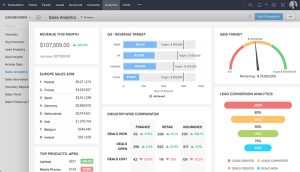
Zoho CRM unifies sales, marketing, and customer support through customizable workflows and multichannel communication. Its AI assistant, Zia, provides predictive lead scoring, forecasting, and generative tools for emails and reports.
Best for: Small to medium sales teams
Key features:
- Enables centralized customer engagement across email, phone, live chat, and social media
- Customizable modules, layouts, and workflows using Deluge scripting or drag-and-drop tools
- Mobile app for real-time deal updates and call logging, with role-based controls and encryption
Unique differentiators:
- Affordable enterprise-grade features: Broad functionality at lower cost than Salesforce or HubSpot
- End-to-end Zoho ecosystem: 50+ native integrations reduce third-party dependence
- Global privacy focus: Data localization and ad-free, GDPR-compliant infrastructure
Pricing: Free trial with plans starting at $14/user/month
Sales outreach & engagement platforms
Sales outreach platforms turn CRM data into action, helping B2B teams run multi-channel sequences across email, calls, and LinkedIn. They automate and personalize follow-ups while tracking engagement to make outreach timely and scalable. Think of the CRM as the filing cabinet and the outreach platform as the loudspeaker ensuring prospects actually hear you.
| Tool | Best For | Standout Feature | Price |
| Outreach | Mid to enterprise teams | AI revenue agents with branching workflow logic | Custom pricing |
| Salesloft | Mid to enterprise teams | Workflow orchestration engine | Custom pricing |
| Apollo | Small to medium teams | All-in-one prospecting and engagement stack | Free tier available (paid at $49/user/mo) |
| Mixmax | Small to medium teams | Lives inside your inbox (Gmail/Outlook) | Free tier available (paid at $29/user/mo) |
Outreach

Outreach helps B2B teams automate and scale multi-channel sales sequences across email, calls, and LinkedIn. Its AI predicts deal outcomes, drafts personalized messages, summarizes calls, and handles routine tasks, turning the CRM’s data into real execution power.
Best for: Mid to enterprise sales teams
Key features:
- Multi-step sequences with branching logic, pause rules, and automated follow-ups
- Real-time call guidance, sentiment analysis, and post-meeting coaching
- CRM integrations that auto-sync emails, calls, and replies
Unique differentiators:
- AI revenue agents: Autonomous agents for prospecting, research, and next-step recommendations
- Adaptive sequence logic: Behavior-based workflows across email, calls, and social channels
Pricing: Available upon request
Salesloft

Salesloft helps revenue teams automate outreach, coordinate buyer journeys, and optimize engagement across email, calls, and social channels. Its AI assists with drafting messages, scoring deals, prepping meetings, and summarizing conversations, reducing manual work for reps.
Best for: Mid to enterprise sales teams.
Key features:
- Structured outreach flows with branching logic and automated follow-ups
- AI meeting briefs with deal context and post-call summaries with action items
- Automatic detection and addition of new stakeholders to deals
Unique differentiators:
- Workflow orchestration: Intelligent engine that prioritizes and sequences tasks dynamically
- Fast time-to-value: Quick implementation, high platform stability, and enterprise-ready controls
Pricing: Available upon request.
Apollo

Apollo combines B2B data and sales engagement in one platform, helping teams find, contact, and convert prospects efficiently. Its database powers advanced prospecting, automated outreach, and AI-driven follow-ups across the sales cycle.
Best for: Small to medium sales teams
Key features:
- Real-time CRM sync with enriched prospect and account data
- Company lookalike modeling and predictive lead scoring
- Call transcription, key-moment detection, and auto-generated follow-ups
Unique differentiators:
- All-in-one data and engagement stack: Combines contact intelligence with campaign sequencing. No need for separate providers
- Advanced filtering and scoring: Hundreds of attributes and predictive models for precise segmentation
Pricing: Free tier available. Paid plans start at $49/user/month.
Mixmax

Mixmax is a sales engagement platform that lives in your inbox, helping teams run sequences, automate follow-ups, and book meetings without switching apps. Its AI tools draft and polish emails, optimize send times, and adjust outreach when prospects are out of office.
Best for: Small to medium sales teams
Key features:
- Automated engagement sequences across email, calls, social, and tasks
- One-click scheduling links, shared calendars, and inbox-based availability sync
- Real-time notifications for opens, clicks, replies, and engagement scoring
Unique differentiators:
- Inbox-first design: Works inside Gmail and Outlook for faster adoption and less friction
- Meeting copilot: AI summaries, transcripts, and follow-up drafts to maintain deal momentum
- Email deliverability success tools: Email verification, blacklist monitoring, and domain health tracking
Pricing: Free tier available. Paid plans start at $29/user/month.
AI video GTM platforms
AI video platforms help B2B teams stand out by creating personalized video messages, demos, and follow-ups at scale. They can auto-generate scripts, captions, or AI avatars so reps don’t need a film crew, and built-in analytics show who watched what to guide smarter follow-ups.
| Tool | Best For | Standout Feature | Price |
| Vidyard | Mid to enterprise teams | Video Agent automates creation and delivery | Free tier available (paid at $59/user/mo) |
| BombBomb | Mid to enterprise teams | Videos play directly inside emails | $36/user/mo |
| HeyGen | Growing marketing teams | 175+ languages with voice cloning | Free tier available (paid at $24/user/mo) |
| Synthesia | Global enterprise teams | Long-form video with branching scenarios | Free tier available (paid at $18/user/mo) |
Vidyard

Vidyard is an end-to-end video selling and hosting platform for revenue teams. It helps reps create personalized videos that boost engagement and shorten sales cycles. With AI Avatars, teams can generate lifelike videos using their own face, voice, and background from a simple script or text prompt. Video Agent automates video creation and delivery based on prospect actions, adding a human touch at scale.
Best for: Mid to enterprise sales teams
Key features:
- Record and share personalized one-to-one videos with instant view notifications
- Automate video creation and delivery with AI Avatars and Video Agent, triggered by CRM or sales actions
- Identify and share top-performing videos, scripts, and CTAs across teams
Unique differentiators:
- Agentic AI video creation & delivery: Video Agent automates video generation and delivery based on buyer behavior for dynamic, trigger-based personalization
- Deep analytics: Tracks watch time, drop-offs, and link clicks, syncing insights back to CRMs and GTM tools
- Built for revenue teams: Combines video hosting, personalization, and automation in one platform purpose-built for revenue teams
Pricing: Free tier available. Paid plans start at $59/user/month.
BombBomb

BombBomb is a video messaging platform for sales, marketing, and customer teams. It lets users send personalized video emails, screen recordings, and campaigns directly from their inbox or mobile device. Its AI tools generate speaker notes, titles, summaries, and audio enhancements to speed up video creation.
Best for: Mid to enterprise teams
Key features:
- Record screen, webcam, or both on desktop or mobile
- Add clickable in-video banners to guide viewers toward actions like booking a meeting or visiting a webpage
- Edit videos and access basic viewer analytics
Unique differentiators:
- Email embedding: Pioneered playable video embeds within emails, with instant view notifications
- In-video CTAs: Clickable banners and calls-to-action drive engagement without separate landing pages (similar feature to Vidyard)
Pricing: Starts at $36/user/month.
HeyGen

HeyGen is an AI video generation platform that turns text, images, or audio into realistic, avatar-driven videos with lifelike lip-sync and emotion. Users can clone voices, translate scripts, and automate scenes, making it easy to create multilingual, on-brand content at scale.
Best for: Growing marketing teams
Key features:
- Create custom avatars from a photo or video, with outfit and style options
- Choose from 100+ avatars and 300+ voices across 175+ languages and dialects
- Connect to streaming software to feature avatars in live broadcasts
Unique differentiators:
- Video localization: Voice cloning, dubbing, and lip-synced translation across 175+ languages
- Extensive avatar and voice library: 100+ avatars and hundreds of voices for diverse styles and personas
Pricing: Free tier available. Paid plans start at $24/user/month.
Synthesia

Synthesia is an AI video platform that creates human-like videos without cameras, actors, or studios. Its avatars speak 140+ languages with natural lip-sync and emotion, automatically translating and updating content across markets to keep it on brand.
Best for: Global enterprise teams
Key features:
- 230+ avatars and 140+ languages and accents for realistic voiceovers
- Multi-avatar scenes for simulated conversations
- Video templates and media assets for easy customization
Unique differentiators:
- Interactive video capabilities: Supports branching scenarios and clickable elements for more engaging viewer experiences
- Asset conversion and localization: Turns slides, PDFs, or scripts into polished videos, with re-dubbing and translation that preserve lip sync
- Long-form video creation: Produces consistent, multi-hour videos ideal for training and internal communications
Pricing: Free tier available. Paid plans start at $18/user/month.
Modernizing your sales stack
You’ve already got a suite of sales tools (and we’re willing to bet some aren’t even being used!).
That’s why we go back to our main point: sales tools shouldn’t just be about automating tasks and increasing productivity; they should be about building rapport and trust with your buyers!
Modernization and efficiency come from optimizing the stack, not just adding tools. Here’s how to do just that.
Sequence your tools effectively
Your CRM should be the foundation of your sales tech stack. Without a steady foundation, adding other tools may make life harder for your sales team. Layer outreach, enablement, and video tools strategically on top..
Leverage AI for productivity gains
Artificial intelligence offers a powerful way to enhance sales productivity, but its real value goes beyond simple automation. Trust remains the cornerstone of successful selling, and AI should enhance authenticity. By equipping sales professionals with the right information at the right time, AI enables them to demonstrate empathy, anticipate concerns, and deliver personalized solutions.
Eliminate redundancies and tool sprawl
Many organizations accumulate overlapping tools over time — multiple platforms for communication, data management, or project tracking — that create confusion rather than clarity.
This overlap wastes money and leads to fragmented workflows, where teams switch between systems unnecessarily and risk losing valuable information. Regular audits help uncover these redundancies, allowing you to identify where tools are duplicating functions and streamline operations.
Redefining sales productivity around buyer trust
Let’s be honest: sales productivity isn’t about who can stack the tallest pile of shiny tools. Tools are helpful, but they’re just one piece of a much bigger puzzle. The real challenge isn’t adopting tech for tech’s sake — it’s using the right tools to build trust with buyers. If the tech isn’t helping you connect authentically, it’s just noise.
Why efficiency metrics miss the point
If you think firing off more emails or logging more calls equals productivity, are you stuck in the ‘80s? All that does is bury buyers under an avalanche of outreach, leaving them fatigued and less likely to engage. Productivity isn’t about volume; it’s about resonance.
In a world where buyers receive dozens or hundreds of emails every day, simply hitting the inbox isn’t enough. Focus on the metrics that really matter: response rates, meetings scheduled, and closed deals.
Trust and engagement as the real drivers of productivity
Here’s the thing: buyers don’t remember how many calls you logged or how fast you replied to an email — they remember how you made them feel.
Did you understand their problem? Did you show up as a partner instead of a pushy seller?
Real productivity comes from trust. Trust keeps conversations moving forward and keeps competitors at bay. Without it, even the most “efficient” outreach strategy is just background noise.
When buyers feel understood and respected, they respond, share more openly, and are willing to invest time in the relationship. That’s when deals accelerate: because you’re no longer just another vendor, you’re the advisor they want at the table.
And that’s the multiplier effect: trust builds engagement, engagement drives momentum, and momentum closes deals.
How modern tools help reps earn and scale authentic buyer connections
Modern platforms enable personalization at scale, meaning a rep can send a message that feels handcrafted to a buyer’s unique needs without spending hours tailoring every word.
From personalized video messages to personalized landing pages, these tools add a human touch that cuts through the digital clutter. Instead of feeling like just another prospect in a spreadsheet, the buyer feels seen.
Analytics are just as critical, showing not only who opened an email but who engaged deeply: what they watched, clicked, or re-read. It’s the difference between guessing what a buyer might care about and knowing what actually resonates.
AI ties it all together by helping teams prioritize the right leads, craft smarter outreach, and continuously improve. Rather than replacing the human element, AI amplifies it, surfacing opportunities for empathy and connection at scale.
How video transforms sales productivity
Most tools force you to pick a lane: do you want efficiency, or do you want engagement? Video delivers both.
In the age of AI, a personalized video is faster to create than typing a perfectly crafted email, yet it lands with the impact of a face-to-face conversation. The result: reps get more done and buyers actually pay attention.
The power of video doesn’t stop after initial contact. Here are a few ways video can help your team stand out.
Prospecting and outreach
Forget the endless wall of text. A quick 45-second personalized video cuts through inbox clutter and gives prospects a face, a voice, and a reason to reply. It’s harder to ignore a human being than another bland subject line.
The data backs us up: using video for sales outreach has increased response rates for more than 60% of sales reps. Want some specific examples? Check out our case studies.
Pipeline and deal management
Account executives can ditch marathon calls by sending concise recorded demos, pricing walk-throughs, or recap videos. Buyers can replay, share with stakeholders, and come to the next meeting already aligned. This flexibility shortens deal cycles because decisions don’t stall while waiting for the next live call.
Customer engagement and retention
The magic doesn’t stop once the ink dries. Video helps maintain relationships post-sale — whether it’s a quick thank-you, a product update, or a renewal check-in. Instead of feeling like a transaction, customers feel remembered and supported.
As we wrap things up, we want to check in again. We hope you’re feeling more understood, as we get the problems salespeople are facing in today’s crazy world.
We also hope you’re feeling more empowered to boost productivity with the human touch we know is at the heart of sales.
As we go further into the age of AI, using outdated and disconnected tools will only continue to cause your team problems, and ultimately result in missed quotas and declining revenue growth.
But the great news is that AI unlocks a world of opportunity to not only scale productivity, but scale personalization and build trust. Here at Vidyard, we believe that the best sales tools help every team member show up authentically while ensuring every prospect gets the same level of attention.
Which type of sales productivity tools should I implement first?
In general, we recommend starting with nailing the foundation first. This doesn’t just mean having a CRM and data enrichment sources, but ensuring that you’re getting the most juice out of the squeeze!
How do I check if a productivity tool will integrate with my existing GTM stack?
Most of the time, a platform will provide a list of integrations directly on their website. You can also contact them or see if tools like Zapier can solve any integration issues.
How can I drive adoption of new productivity tools without overwhelming reps?
Reps are busy, and you want them focused on the most important task: driving revenue. Rather than handing them a new tool, get them involved in the selection, testing, and rollout process. Throughout this, make sure they realize the value of the tool in helping them achieve their goals, hit their quotas, and ultimately make more money for the company and themselves.
What metrics best measure sales productivity tool ROI?
To measure the ROI of a sales productivity tool, focus on both financial gains and efficiency improvements. Key financial metrics include revenue growth, cost savings, and sales per representative, which help determine if the tool’s benefits outweigh its cost. Productivity metrics such as reduced sales cycle length, and higher conversion rates. Additionally, adoption rates and user satisfaction should be tracked to actually ensure the tool is being used and driving long-term value.
How can AI boost sales productivity?
AI boosts sales productivity by taking over the tedious stuff — think data entry and lead scoring — so reps can focus on closing deals. It spots hot leads, predicts trends, and helps tailor pitches for better results. Basically, it’s like having a smart sidekick that makes selling faster and easier.
With Vidyard, teams can utilize our AI Avatars and Video Agent to automatically create and send personalized videos based on actions prospective buyers take, so every rep performs their best and every prospect gets the same level of attention.
What are the risks of too many sales productivity tools?
Having too many sales productivity tools can backfire by overwhelming reps with constant logins, alerts, and data silos. Instead of saving time, it can create confusion and reduce focus on actual selling. Data may become fragmented across platforms, making reporting and collaboration harder. In short, tool overload can drain efficiency rather than boost it.
