


Support CleanTechnica’s work through a Substack subscription or on Stripe.
Hyundai invited CleanTechnica into its brand new automotive factory where it is building the IONIQ 5 and IONIQ 9 for US customers. It’s located a few minutes outside of Savannah in Ellabell, Georgia.
Disclaimer: Hyundai paid for the author’s travel and accommodations to attend this event in Savannah, Georgia.
The Hyundai Motor Group Metaplant America (HMGMA) is the official name of the new factory and represents a massive investment for the company. It singlehandedly represents the largest investment ever in the state of Georgia as part of Hyundai’s much larger investment in expanding its US manufacturing footprint.
The first thing that strikes you about the Hyundai Metaplant is how clean and quiet it is. It’s clear they put a ton of work into streamlining the processes of course, but also into the human side of the factory. Instead of massive conveyors that break up the space and form a rigid production flow, they opted for autonomous guided vehicles (AGVs) to carry their vehicles around in the factory.
A Master-Planned Factory
The flow of the overall plant was done with clear intention. The company has nearly 3,000 acres of land and continues to build out even more business units as its operations expand. The initial scope was to produce 300,000 vehicles per year, but just last year it committed to expanding operations and increasing its total output capacity to 500,000 vehicles per year.
Today it is producing the IONIQ 5 and IONIQ 9 for the US market at its factory just outside Savannah, Georgia. It’s one of those things that doesn’t click immediately until you see just how much of an impact those jobs are having on real Americans today.
It’s not just the 8,500 direct jobs Hyundai has created at its facility but also the 6,950 jobs Hyundai has created indirectly through suppliers and supporting businesses in the region.
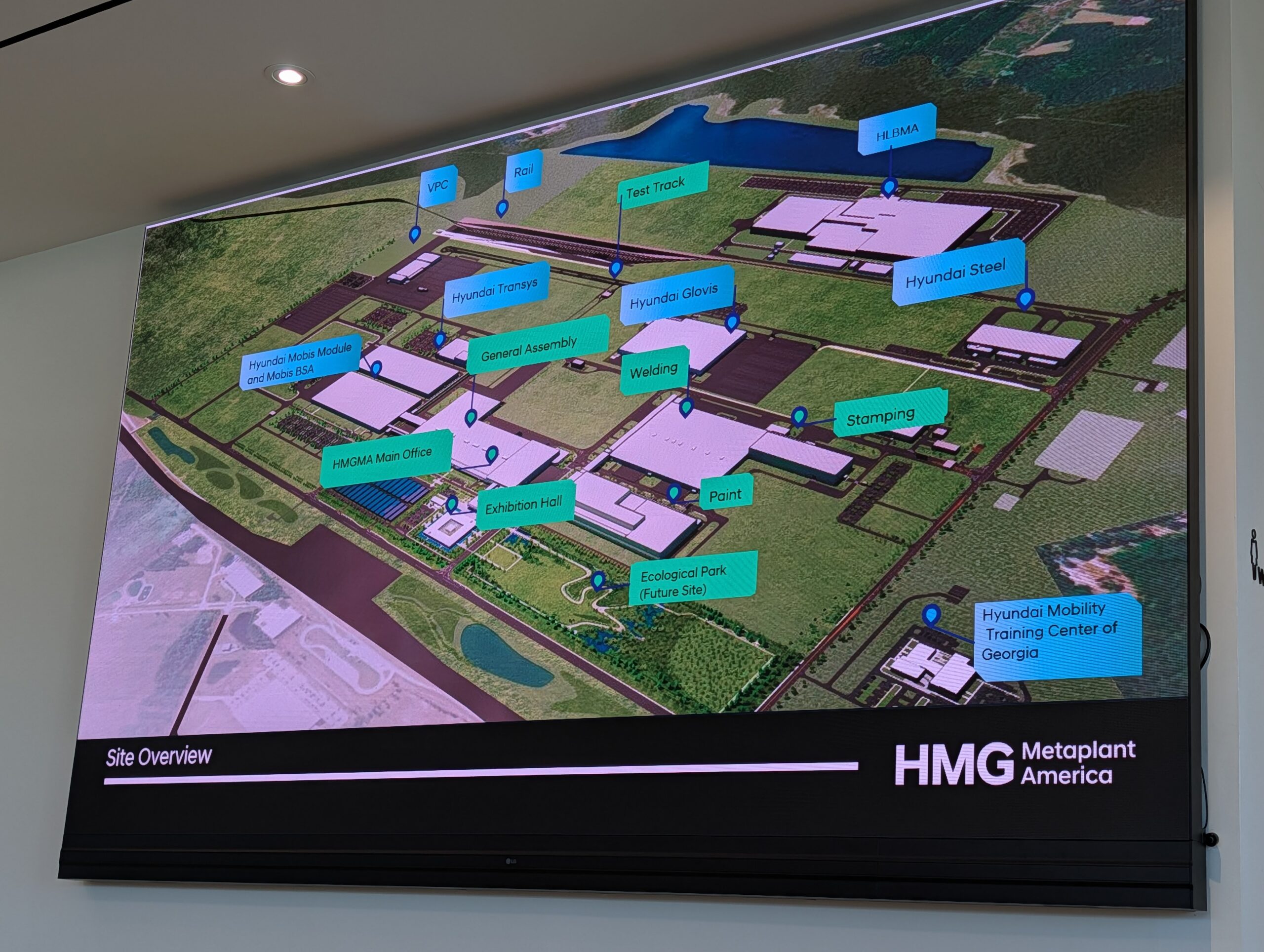
From the start, the plan was to build a factory that included its core vendors at the same location. This includes both Hyundai conglomerate companies like Hyundai Steel as well as external vendors with co-located facilities at the Metaplant.
Inviting vendors and partners bids in to the Metaplant to build their own factories within a factory optimizes logistics and increases the agility of its partners. It’s far easier to walk over to the next building to meet with your supplier than it is to arrange a call and try to work through something remotely. Co-locating vendors also means a shorter supply chain which ties up less money and inventory enabling faster response times in the event of changes.
AGVs
Using AGVs comes with its own set of pros and cons. They offer far more flexibility in where vehicles are cued up where they can accumulate in the factory and where they can go in the event of a production line change. It’s the equivalent of a digital solution on the factory floor, which stands in stark contrast to the rigid flow of a more traditional automotive factory conveyor.

On the other hand, adding hundreds or thousands of robots that have to be individually maintained, charged, and directed opens up a range of new challenges for Hyundai. That’s typically something that hits hardest at launch when they’re trying to program the beautiful symphony of vehicles and then farther down the line when they start to need maintenance.
A Silent Stamping Press
The stamping press is the heart of any automotive factory. It takes rolls or sheets of steel and aluminum and pounds them out into body panels for the vehicles. This requires monolithic sets of precision dies that stamp the parts and the oversized machines that pound out the body panels.
With so much force being applied to literally shape sheets of raw metal into automotive parts, the stamping press is almost always offensive to the senses. The loud noises and the shock of the massive dies clanging into each other over and over as parts are shaped is extremely hard to manage. The stamped body panels are immediately moved to the body shop where they are welded together with a fleet of robots and checked for quality.
Hyundai is clearly proud of the stamping press it put together with its many layers of safety of course, but also the noise dampening and shock absorption that’s built into it. Those additions transforms the stamping press area from an abrasive part of the plant into something that can be walked around and worked in without hearing protection.
State Support
The state of Georgia has played a large role in bringing Hyundai to the area and continues to support its operations. The state was instrumental in securing such a large parcel of land for the Hyundai Metaplant and even built a state-owned and run training facility that provides some of the first modules of training for Hyundai’s new hires.
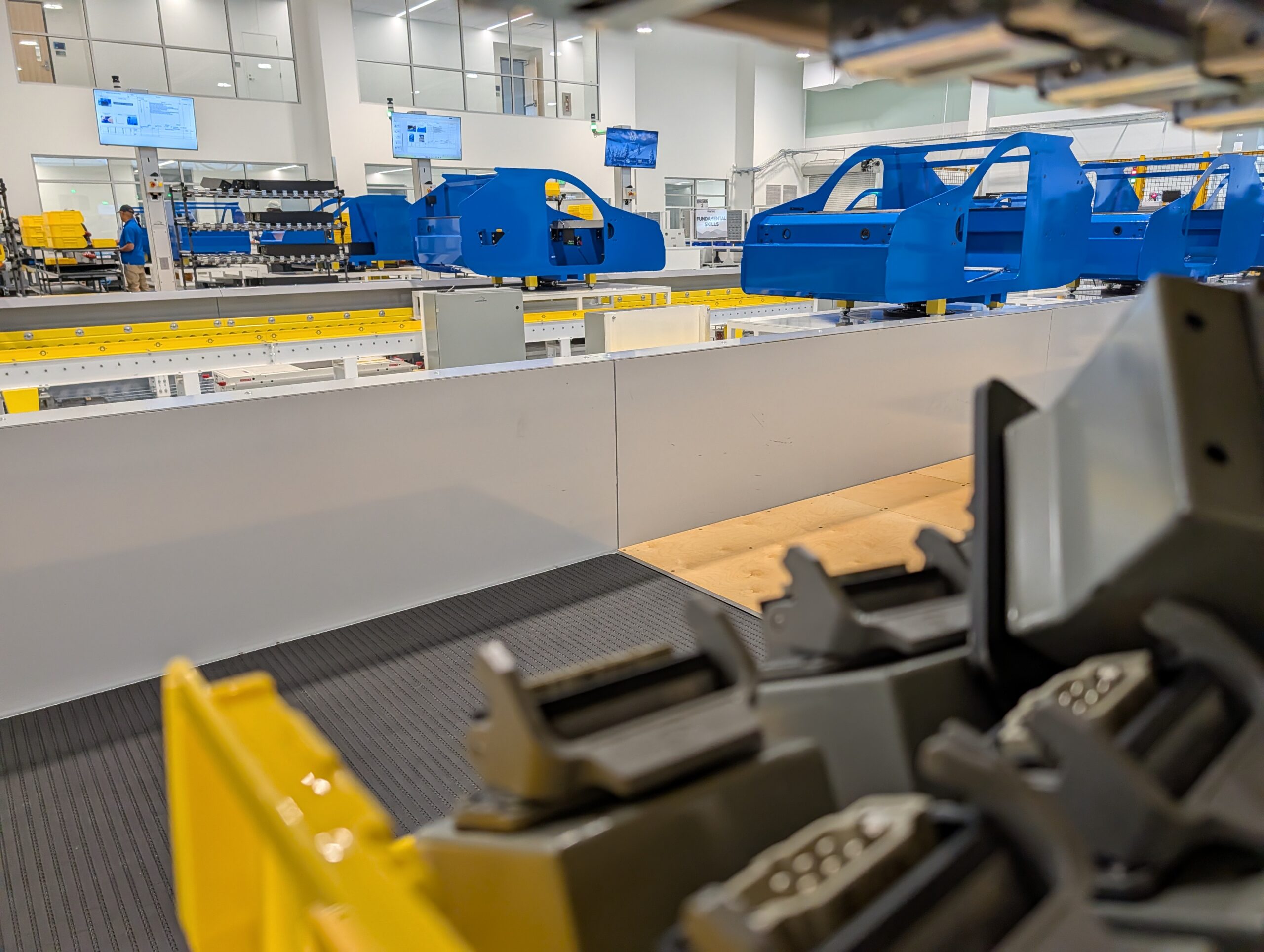
It’s a critical layer of support that enabled Hyundai to invest in Georgia in a significant way, knowing that they would be able to build up a sizable workforce in the area to build its vehicles.
Overall
A huge part of Hyundai’s plans for the US market is the single core focus for Hyundai in the coming months and years. The company’s CEO said that he sees a significant amount of potential for Hyundai to expand in the US market in the near term.

For legacy automotive manufacturer, Hyundai continues to design and build some of the most attractive EVs on the market. Personally, I would call them the most exciting EVs from a legacy manufacturer in the US.
Either way, it’s great to see automotive manufacturers investing in local production with a holistic vision that brings more zero emission vehicles to US customers and supporting the local economy along the way.

What are your thoughts? Hit us up in the comments below and let us know what you think about and nice new factory and their US focus moving forward.
Sign up for CleanTechnica’s Weekly Substack for Zach and Scott’s in-depth analyses and high level summaries, sign up for our daily newsletter, and follow us on Google News!
Have a tip for CleanTechnica? Want to advertise? Want to suggest a guest for our CleanTech Talk podcast? Contact us here.
Sign up for our daily newsletter for 15 new cleantech stories a day. Or sign up for our weekly one on top stories of the week if daily is too frequent.
CleanTechnica uses affiliate links. See our policy here.
CleanTechnica’s Comment Policy
